
To say that footwear sizing is a mess is an understatement. Different brands have different sizing standards. Even shoes in the same size from the same brand may not fit the same. Here are a few examples of how confusing all this can be:
What is the Asics UK size equivalent of a US 9? The answer is UK 8.
What is the adidas UK equivalent of a US 9? The answer is UK 8.5.
What is the Asics CM (JP) size equivalent of a US 11? The answer is CM (JP) 28.5.
What is the Brooks CM (JP) size equivalent of a US 11? The answer is CM (JP) 29.
What is the Hoka EU size equivalent of a US 11? The answer is EU 45.
What is the Puma EU size equivalent of a US 11? The answer is EU 44.5.
We can go on forever, but here’s another one. The Nike CM (JP) size for a men’s US 6 is 24. However, the Nike CM (JP) size for a women’s equivalent is 24.5. Brands like Salomon have their sizing charts wrong. At the time of publishing, they label the CM (JP) size as the ‘foot length.’ At least Nike makes it clear that the CM size on the box isn’t the same as foot length.
The CM (JP) value on a box label doesn’t necessarily translate into the actual foot length. That happens because the 0.5 CM step between every half size is 15% greater than the first principles of footwear size conversion. And what is the first principle of footwear size conversion?
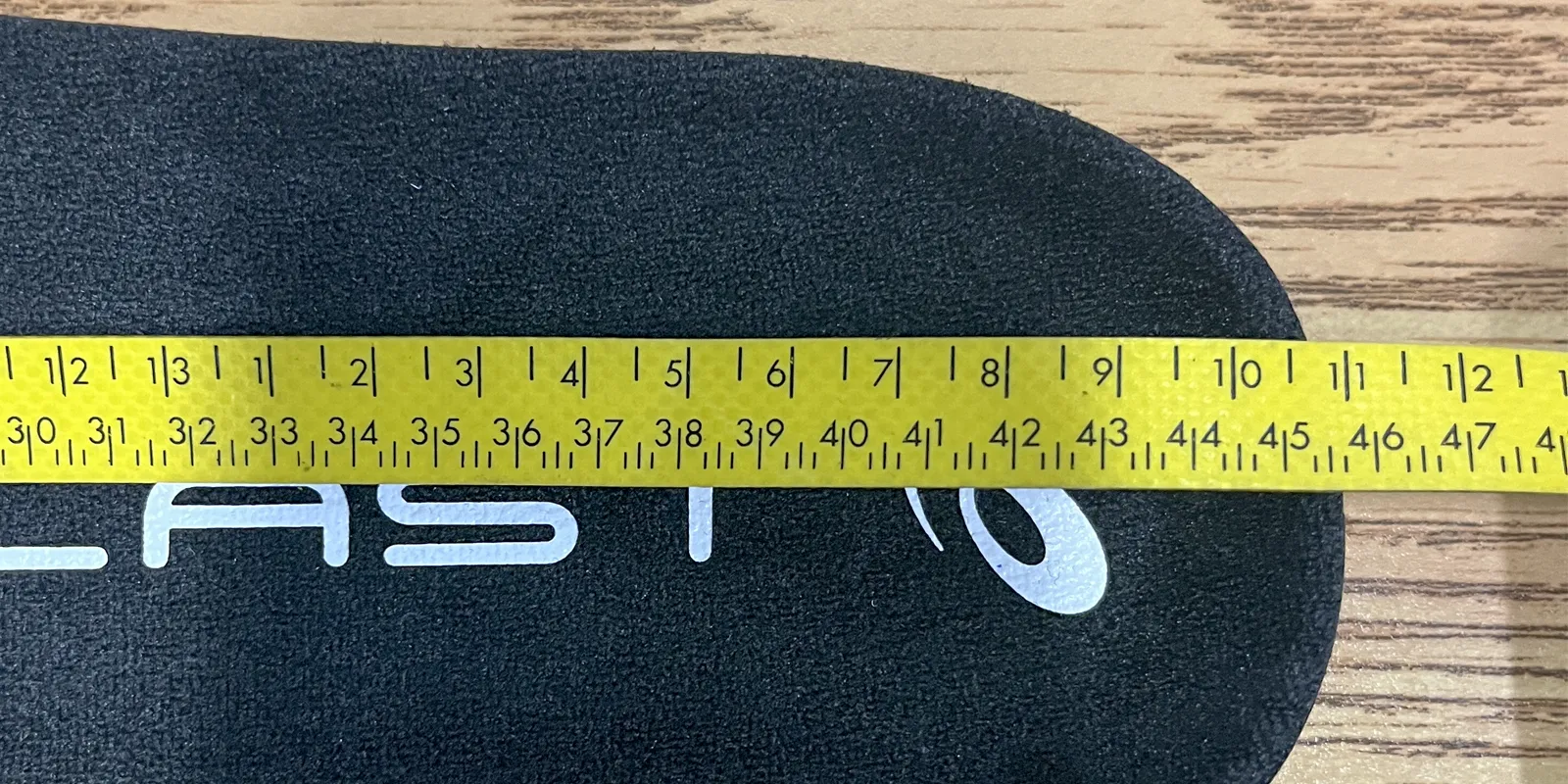
The EU or FR size begins with the first centimeter and progresses at a rate of 3 sizes every 2 centimeters. The UK (Australia uses the same standard) size begins at 4 inches or 10.16 centimeters. Thereafter, each US or UK size advances by 1/3 of an inch, or 0.85 CM. For half sizes, that would translate into 0.425 CM. It’s obvious how the CM (JP) size on the box label falls out of sync as the sizing scale advances.
If the actual difference for a full size is 0.85 CM, then the difference of 1 CM (which the brands based their CM/JP size on) will begin to deviate from the actual foot length with increasing sizes. The brand’s CM (JP) size will accurately reflect the foot length in the smallest sizes. However, by size US 11, we’re looking at an approximate deviation of 1~1.5 CM versus the actual foot length. In other words, a foot length of 28 CM will translate into a CM (JP) size of 29 CM. Some brands get around this by pausing or slowing the 0.5 CM progression midway to ‘catch up’ on the deviation. For example, the Asics CM (JP) size is 28.25 for a US 11 instead of the 28.5 that Brooks and Hoka use. Different brands use varying ‘slowing’ or ‘pausing’ checkpoints to catch up, a factor that makes size conversions all the more difficult.
For far too long, shoe brands have done little to help the general public understand their sizing and fit standards. Even the largest brands, with annual revenues in excess of tens of billions of dollars, have only static (and unintuitive) size charts. The user has to scan these charts row by row to convert sizes. And that’s just the base sizing – those charts don’t account for the differences in sizing between models, or even between successive versions of the same shoe model.
And that’s just the stick length. Brands do not publish their last ball/waist girth and girth grade values by size. The ball girth grade is related to the forefoot and toe-box space, and represents how the circumference of the last (the shape or profile that defines the volume of a shoe) grows from one size to the next. Hoka and New Balance provide their width dimensions, but that’s for the side-to-side length and not the circumference. The width value (provided by the brand) is a two-dimensional measurement; girth is three-dimensional – just like the foot.
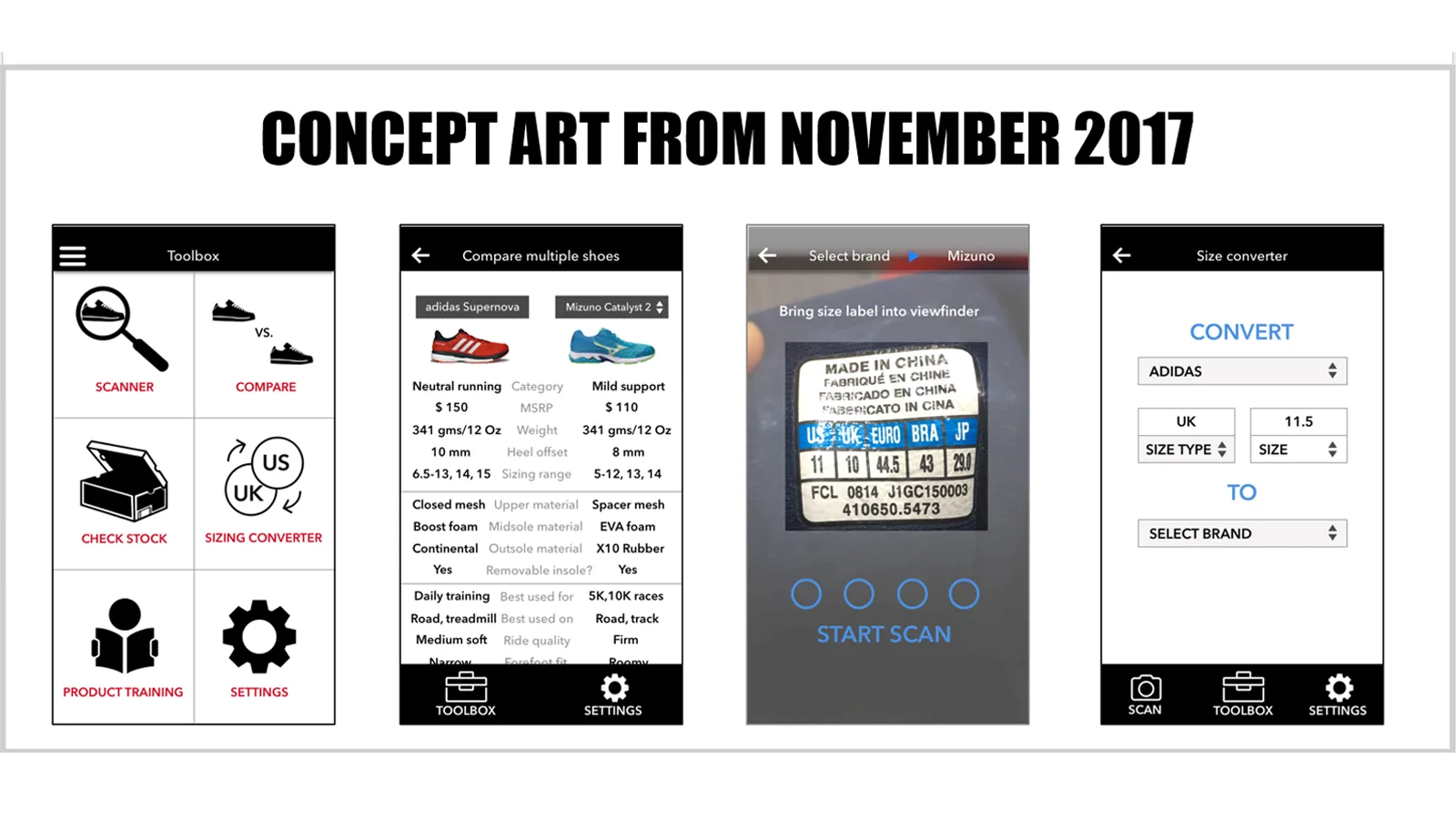
Our concepts from 2017; the mock-up for the sizing converter can be seen on the right.
The idea of creating a dynamic drop-down sizing converter came to us nearly a decade ago when we were prototyping the interface for a footwear product training app. By the way, we used many of those ideas to create our redesigned review format. While we managed to create a working prototype sometime last year, making it production-ready was fun yet frustrating at times. There were six steps involved in creating our suite of footwear size converters:
1) Understanding the variances between different sizing standards: This was the first step. We spent countless hours examining the sizing charts of different brands, and noting down the quirks and idiosyncrasies of each.
2) Sizing standardization at scale: Our sizing database contains thousands of rows, each representing sizes across different brands, often with inconsistent size translations. We first mapped all those sizes to an internal standardization scale. This scale combines the first principles of footwear sizing with manual adjustments (like accounting for the CM sizing increment ‘pause’ by Asics, for example) wherever necessary. This unique approach results in accurate base size translations between brands. We also measured the insoles using a special shoemaker’s tape and cross-checked actual box labels against the published brand sizing charts.
3) Creating manual fit overrides and offsets for individual models: To create a functional model-to-model sizing converter, we catalogued the sizing and fit characteristics of 60 current shoe models across a dozen brands. If a shoe fit smaller than its advertised size due to variances in design and construction, we added a manual ‘override’ or ‘offset’ to the database values.
For example, the 2025 Asics Metaspeed Sky/Edge Tokyo fits a half-size larger due to reduced heel collar padding – that has the effect of shifting the foot away from the toe-box. From a conversion perspective, a runner needs to buy a half size smaller in this model. Our converter translates a US 10 in the Asics Novablast 5 (true to size) into a US 9.5 (half size larger fit) in the Asics Metaspeed Sky and Edge Tokyo.
Shoe brands have a surprisingly nonchalant approach to heel collar design; it should be subject to strict design and production tolerances to prevent sizing mismatches. The same goes for shoes with or without full sleeves – we’re looking at you, Nike Vomero Plus.
4) Adding logic to encounter out-of-bounds sizes at a brand level: One would think that all brands have consistent sizing runs, but that’s not the case. Some shoe size charts begin at ultra-small sizes and extend up to a size 20; others cap at size 16. Our built-in logic doesn’t return the conversion if a particular size is unavailable in the target (convert to) brand.
5) Adding logic to encounter out-of-bounds sizes at a model level: Not all shoe models within a brand are produced in identical size runs. The Saucony Guide 19 is sold up to a size US 16, but the Endorphin Pro 5 is only sold up to a US 15. The adidas EVO SL and New Balance Rebel 5 are sold up to a (massive) US 18; the 1080V15 stops at a size US 16. Our model-to-model and foot length to model sizing converter takes these limitations into account.
This week, we released four unique sizing tools to reduce layers of guesswork. These tools do not promise a perfect fit, given how personal shoes are. However, these size translators are a generational leap from the static and clumsy sizing charts of today. We made two base size translators and two model-specific sizing converters that cater to different levels of size discovery needs.
UNIVERSAL SIZING TRANSLATOR
This base sizing translator converts one of the five sizing standards from one brand to another.
Convert From
Convert To
FOOT LENGTH TO BRAND SIZE TRANSLATOR
This converter takes the true foot length in centimeters and converts it into a specific brand size. Since this converter uses an internally standardized scale and manually calibrated data, the CM value of the foot length may not always be equal to the CM (JP) size. This is because of the CM sizing ‘creep’ explained earlier. We also added helpful instructions on how to properly measure the foot for accuracy.
Foot Length Converter
Translate your foot length into the corresponding shoe size for a specific brand.
MODEL TO MODEL SIZE CONVERTOR
This tool lets the user compare the sizing of two shoes. They can be from the same or different brands. This sizing translator combines our base size conversion data with model-specific sizing overrides wherever applicable. We also added two features that are not available on our base sizing translators. A visual ‘fit bar’ (borrowed from the fit visualizer module in our new review format) tells the reader how the shoe fits. A separate ‘fit note’ box contains insightful information about the specific shoe.
Compare Fit Across Models
Your Size In ...
Fit Profile: ...
FOOT LENGTH TO MODEL SIZE TRANSLATOR
Inputting the foot length into this tool will convert centimeters or inches into a shoe size at a model level. It shares the visual fit bar and fit notes commentary with our model-to-model size converter.
Foot length to model size convertor
Translate your foot length into a shoe size for a specific model.
Your Size In ...
Fit Profile: ...
NAVIGATION CARDS
Helpful navigation cards under each sizing tool redirects the reader to one of the other three sizing converters. In this carousel, we have all four cards.
Try our other sizing tools.
Compare fit across models.
Find out which model runs narrower or wider.
Foot length to brand size.
Convert foot length (cm/in) into a brand's general size.
Universal brand size convertor.
Compare sizing across different major brands.
Foot length to model size.
Convert foot length (cm/in) into a model's specific size.