
Product guide updates
(4 total)- 2026-11-13 — Added 'Top recommendations summary' module
- 2026-11-13 — Added 'the research behind our picks' section
- 2026-11-13 — Migrated product guide to new editorial format
- 2026-11-13 — Updated all primary recommendations

In this product guide:
How we selected
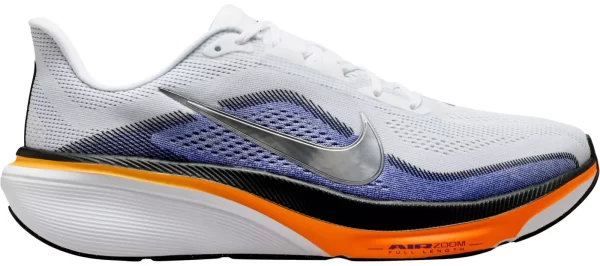
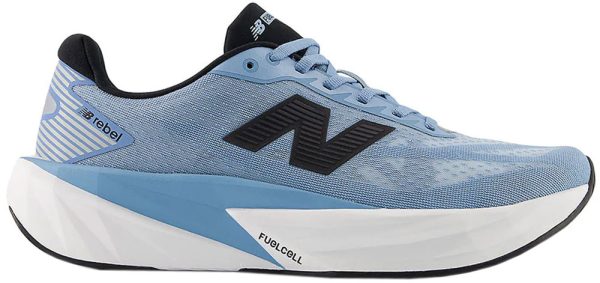
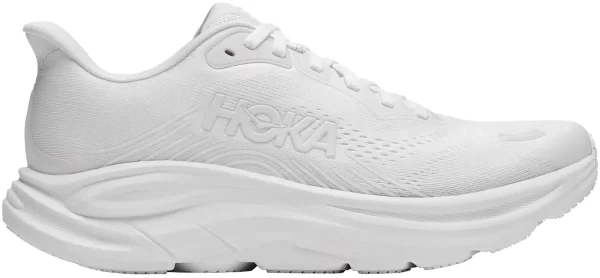
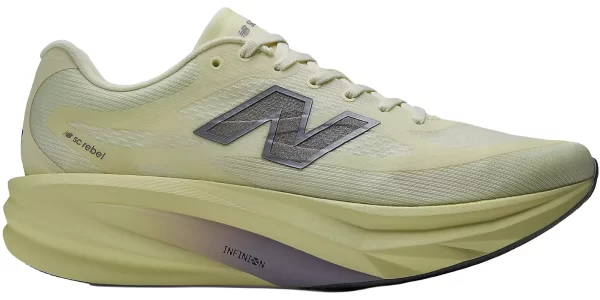
Our recommendations for running shoes that are available in larger sizes are grouped by use cases – daily runs, 10K and marathons, recovery runs, overpronators, and trail. By connecting each feature with its respective function, the “Why it works” section explains why a particular shoe (in its respective class) is suitable for its recommended use case or attribute. Since a larger foot size usually translates into a higher body weight, this guide focuses on supportive running shoes that are suitable for heavy runners with larger feet. For example, the alternatives to the Nike Vomero 18 (our daily trainer pick) are the New Balance Rebel v5 (tempo trainer up to a US 18), the Nike Pegasus 42 (a daily trainer up to a US 18), and the Hoka Clifton 11 (everyday comfort up to a US 16).
- Best for daily runs: Supportive everyday trainers in larger sizes.
- Best for 10K and marathons: An assortment of supportive plated shoes in bigger size runs.
- Best for recovery runs: Stable max-cushioned trainers in bigger sizes.
- Best for overpronators: Large-sized shoes with compression-resistant midsoles.
- Best for trail: Off-road running shoes with extended sizing.
Our recommendations combine our influence-free, expert-led wear-testing with biomechanical data sourced from over 33,000 high-speed images captured during actual road races. We combined our wear-test observations with an evidence-based screening of design features that make a shoe supportive – an important attribute in larger footwear sizes. The ‘Research behind our picks’ section below explains why brands are hesitant to offer larger size runs, and what’s changed in recent years.
The research behind our picks
Why do brands usually cap their footwear sizes at a US 15 or under?
From a sizing perspective, a lot has changed in the last few years. While sizes 17 and 18 are still relatively uncommon, there are plenty of running shoe models that sell up to a US 16. We believe that the transition from brick-and-mortar to online shopping is the catalyst. In the traditional wholesale model, offline retail chains and independent stores did not stock these larger sizes due to merchandising guidelines. The budget was allocated to higher-selling sizes to ensure a higher stock turnover. Anything above size 13 is usually considered a stock risk.
Also, the footwear manufacturing molds and dies are made by size. Additional investment in the production tools for larger sizes has a detrimental effect on the retail price of the shoe. After all, the costs are spread across the entire model. You get the idea. There’s a very good reason why larger sizes weren’t easy to find in the past – because they were not produced in the first place.
However, a natively owned digital shopping experience allows the brands to stock larger sizes because of the higher visibility and centralized distribution systems. The way we see it, the scarcity of large-sized running shoes makes them less of an inventory risk. After all, runners who wear that size are less picky about the styling. Outlet malls are a good place to find plus-size shoes. Stores are usually arranged to promote a self-service model where the shoes are arranged by size. Online retailers make it easy to filter the products by size, so that’s not the problem. However, the shoes are not grouped by their use cases. That’s where this guide tries to help.
On a related note, one of our readers told us about a useful shoe e-retailer called www.oddball.com. They sell large shoe sizes 14 and up. Solereview isn’t affiliated with Oddball in any form, but it’s a great resource for plus-sized shoes – and not just running. Runners with larger feet generally tend to be taller than the average person. A larger frame also equates to more weight, so the shoe needs to be (somewhat) supportive. We’ve kept that in mind while compiling this buyer’s guide, so overly soft shoes are excluded.
It’s not surprising that New Balance offers some of the largest sizes. Also, the brand has always offered multiple widths in most of its shoes. So if you visit a New Balance store – be it online or brick-and-mortar – there’s a high chance that you’ll find a plus-sized running shoe. Nike is catching up too, with the Vomero 18 and Pegasus 42 being sold up to a size US 18.
Why it works (the basics)
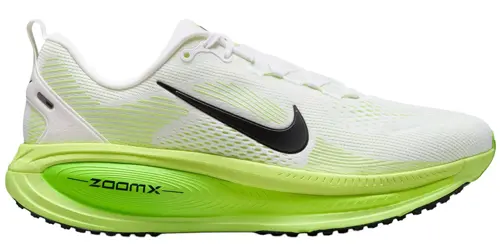
- ReactX midsole base → makes the ride supportive
- ZoomX upper layer → adds comfort without instability
- Sleeved upper → for a smooth and secure fit
- Rocker midsole → makes toe-offs propulsive
🔍 Deep Dive
The usual Vomero 18 size run extends to a US 15. However, if you’re okay with a basic black/white, triple black, or triple white color, then the Vomero 18 is available up to a size US 18. Of all the running shoe models in the Nike catalog, no other shoe checks as many boxes as the Vomero 18. This is a multi-role running shoe that wears many hats, be it that of a daily trainer, a recovery run shoe, or a marathon shoe for over 4:00+ hour finish times. Despite its tall stack heights (45 mm, 35 mm), the Vomero 18 doesn’t come across as sluggish. The midsole appears to have been designed with intent, utilizing a firmer ReactX base for support with a softer ZoomX layer on top for ride comfort. The rocker-shaped forefoot helps with quicker turnovers.
The firmer base also makes the shoe stable enough for larger feet, as bigger sizes are statistically linked to higher body weight. The true-to-size upper has a snug and warm fit because of the full interior sleeve. An optional wide is available, but only up to a size 15; the US 18-sized colors are only sold in a standard width.
Pros
- Ride stability for larger feet
- Rocker-assisted transitions
- Secure fit
- Versatile character
- Long-distance comfort
Cons
- Traction on wet is OK
- Full sleeve limits ventilation
- No half sizes after US 13
Other versatile daily trainers in larger sizes
Fit Notes
Fits true to size with a plush interior. Fully sleeved, so runs slightly warm. An optional wide is available up to a US 15.
Specs
- Heel stack: 44 mm
- Forefoot stack: 34 mm
- Drop: 10 mm
- Weight: 11.5 oz / 327 gms
- Widths: Regular, wide
- Midsole: ReactX, ZoomX foam.
- Insole: Molded, removable
Why it works (the basics)
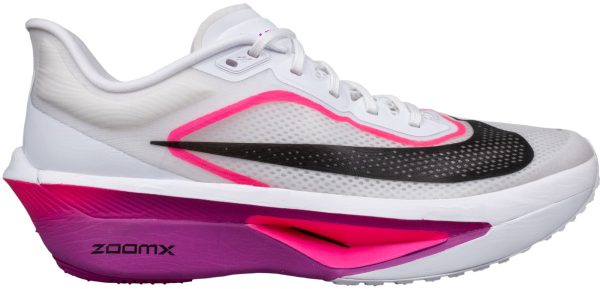
- Dual-density midsole → blends comfort with support
- Full-length carbon Flyplate → adds stiffness and propulsion
- 40 mm, 32 mm stack heights → provides long-distance comfort
- Fully sleeved upper → wraps securely in a true-to-size fit
🔍 Deep Dive
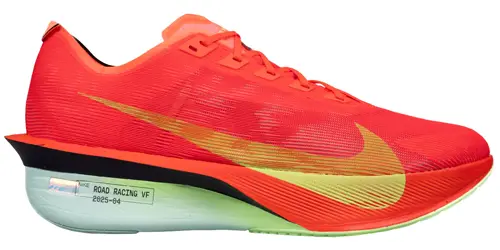
The Nike Zoom Fly 6 has been around for a few years now, so we had multiple opportunities to observe this shoe at different road races. As you know, we capture high-speed images from actual road races several times a year. In the thousands of frames that the Zoom Fly 6 has been in, it has always come across as a biomechanically sound running shoe that accommodates a wide range of gait, body weight, and foot-strike variables. The shoe owes its supportive ride quality (essential for larger feet) to its dual-density midsole and a secure upper. While the text ‘ZoomX’ is prominently displayed on its side, most of the midsole uses a firmer EVA foam blend (Nike SR-02) as its base. This stacking combines the comfortable softness of the ZoomX foam over a supportive platform.
This carbon-plated shoe delivers superior versatility over high-end racers. The stable yet cushioned midsole is more usable and is capable of the mundane. While it likes to go fast, courtesy of the plate, rocker midsole, and secure upper lockdown, it doesn’t complain when a runner wants to run slow or heel strike. With ample outsole coverage under the forefoot and heel, it delivers higher mileage than lighter super-shoes. The Zoom Fly 6 is available up to a US 15; additional widths are unavailable.
Pros
- Speed-friendly midsole
- Blends stability with comfort
- Heel-strike-friendly
- Propulsive rocker and plate
- Excellent lockdown
Cons
- No optional widths
Other 10K and marathon shoes in bigger sizes
Fit Notes
True to size with a narrow forefoot and a spacious toe box. No optional widths.
Why it works (the basics)
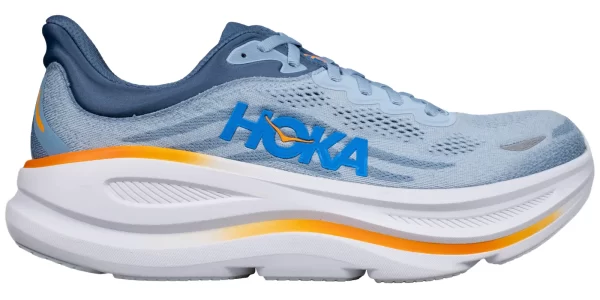
- 42.5 mm, 35.5 mm stack → produces soft max-cushioning
- Wide midsole footprint → creates a supportive platform
- Soft, true-to-size upper → delivers secure lockdown
- Optional wide, extra-wide → offers additional upper space
🔍 Deep Dive
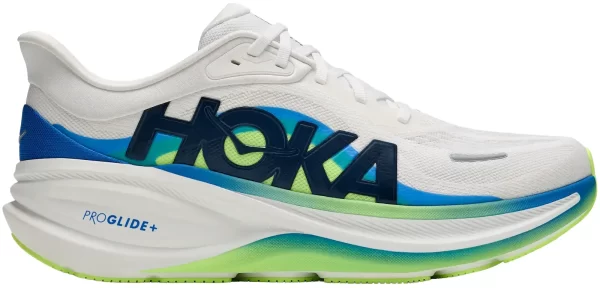
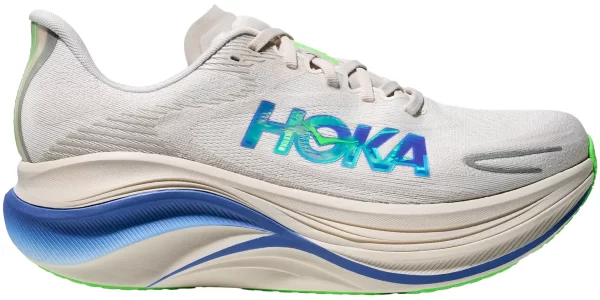
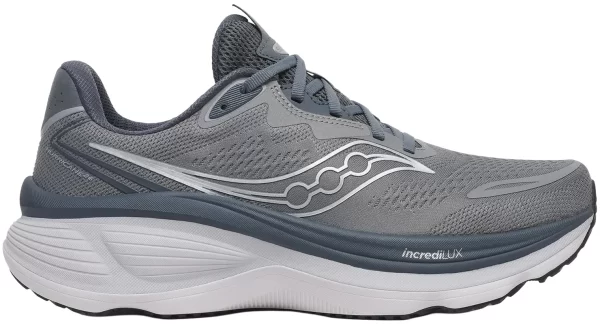
Hoka reserves its US 16 size runs only for its most popular models, namely the Bondi, Clifton, Rincon, and the Gaviota. The rest of Hoka’s line is capped at a size US 15. One good feature about Hoka’s size US 16 models is that they are available even in their wide and extra-wide variants, which is something brands such as Nike don’t offer. Take the Bondi 9, arguably Hoka’s most popular shoe that kickstarted the max-stack trend. This ultra-cushioned shoe is sold up to a size US 16 in all three widths and all colors – not just boring triple black or black/white.
The Bondi 9 is a refined Bondi, one that’s vastly superior to the mediocre Bondi 8. The true-to-size upper is soft and secure, with no pressure hot spots or uncomfortable narrowness. Given its compression-molded EVA foam composition, the midsole isn’t the epitome of energetic bounciness, but delivers a comfortable ride that keeps well clear of mushy territory. While not a speed-going shoe by any means, the stiff forefoot and rubbery softness work together to deliver smooth and mildly propulsive transitions.
Pros
- Comfort for long and easy runs
- Wide supportive base
- Outsole traction
- Plush, secure fit
- Size 16 in all three widths
Cons
- Below average outsole durability
- Heavy by modern standards
- Runs warm due to thick mesh
- EVA foam stiffens in freezing temps
Other recovery run trainers in larger sizes
Fit Notes
Fits true to size with a snug forefoot and roomy toe box. Wide and extra-wide widths are optional.
Why it works (the basics)
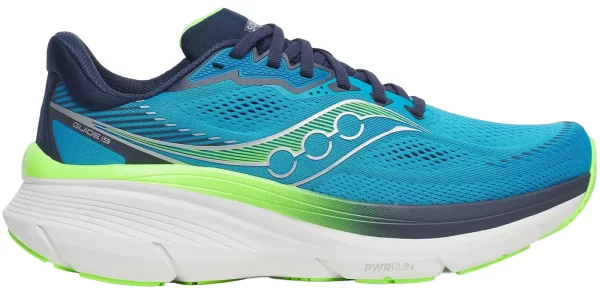
- Wide footprint → offers planted ride and transitions
- PWRRUN EVA foam-blend → minimizes excessive roll
- 35 mm, 29 mm stack → delivers stable cushioning
- Chunky E-TPU insole → adds immediate step-in softness
🔍 Deep Dive
The Guide 19 doesn’t feature complex midsole frames or medial posts, but relies on an architecture that’s deceptively simple yet effective. The shoe owes its compression-resistant character to a firm and wide midsole made of an EVA foam blend (PWRRUN). Unlike modern super-foams, PWRRUN maintains its structure under excessive inward loading on either side, making it ideal not just for overpronators, but for oversupinators as well. Midsole softness is inversely proportional to overall stability, so we’re happy to see that the Guide 19 hasn’t succumbed to the epidemic of overly soft shoes. Bigger feet usually mean heavier body weight, so midsole support is essential. The midsole walls are also raised on the sides of the heel to keep the foot seated.
If you’re looking for softness, you won’t find much of that here – at least by modern standards. Like we said, that’s not a negative in the context of overpronation resistance. The only layer of softness is found in the chunky E-TPU insole that adds immediate underfoot comfort. The midsole design prioritizes stable comfort over sensory softness, with its 35 mm and 29 mm stack heights proving sufficient for runs up to a marathon distance. The true-to-size upper has a spacious toe box and is sold up to a size US 16, wide and extra-wide widths included.
Pros
- Compression-resistant midsole
- Optimal blend of comfort and stability
- Step-in comfort from the insole
- Secure fit, roomy toe box
- Up to size 16 in all three widths
Cons
- Cushioning feels ‘flat’ by modern standards
Other overpronation-compatible shoes in larger sizes
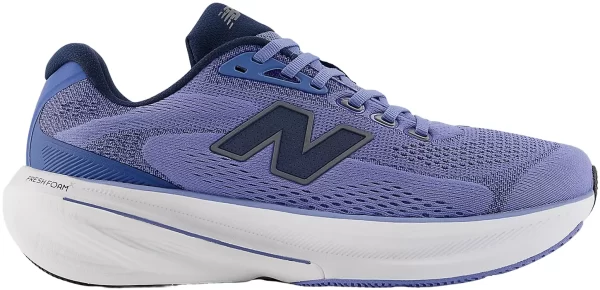
New Balance 860v15 (US 16)
Replicates the traditional medial-side midsole tilt.
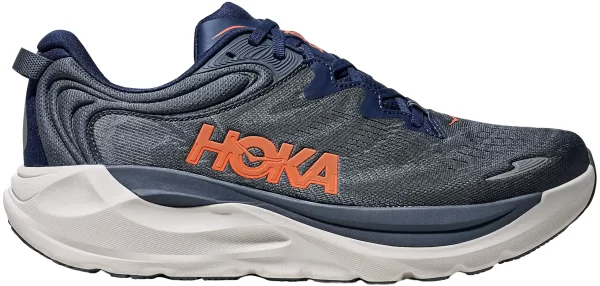
Hoka Gaviota 6 (US 16)
Works better for heavier overpronators than the Guide 19.
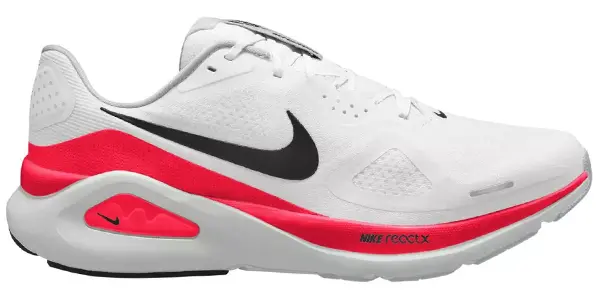
Nike Structure 26 (US 15 )
If you like a softer ride with mild support
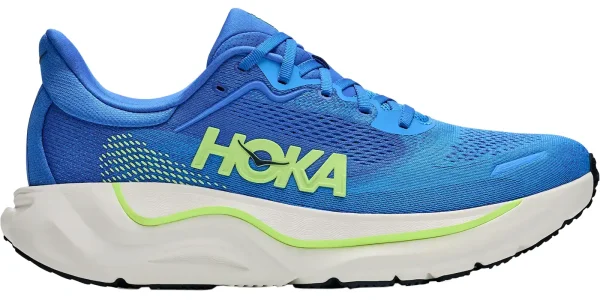
Hoka Arahi 9 (US 15)
A toned-down, milder variant of the Gaviota.
Fit Notes
True-to-size fit with roomy toe box. Gusseted tongue; also sells in optional wide and extra-wide widths.
Specs
- Heel stack: 35 mm
- Forefoot stack: 29 mm
- Drop: 6 mm
- Weight: 9.7 oz / 275 gms
- Widths: Regular, wide, extra-wide
- Midsole: Injection-molded EVA foam
- Insole: Molded, removable
Why it works (the basics)
- Wide Fresh Foam X midsole → for supportive trail comfort
- Vibram Megagrip outsole → grips on trail and road
- Firm midsole → prevents excessive compression
- Optional wide and extra-wide → accommodates wider feet
🔍 Deep Dive
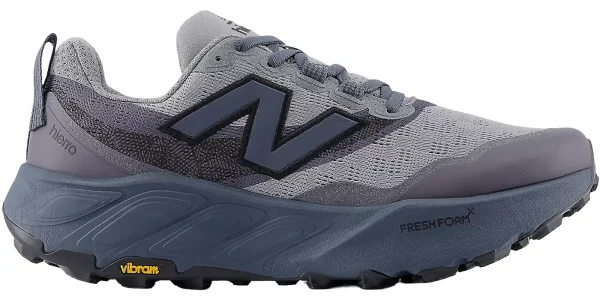
While there are many trail-running shoes sold up to a size 15 (see our recommended alternatives below), only the New Balance Hierro is sold up to a size US 17, and that too in all three available widths and even the waterproof (Gore-Tex) variant. As a shoe, the Hierro leans heavily towards a road-trail hybrid approach, rather than a product designed for hardcore off-road performance. We’d like to clear up another aspect of the Hierro. New Balance advertises the cushioning as ‘very soft’ on the Hierro product page, but that’s not true – at least by contemporary standards. The Fresh Foam X midsole is relatively firm, making it a safe choice for runners with larger feet, as the Hierro resists excessive compression under heavy loads on unpaved trails and roads alike. The removable insole is the only noticeable layer of softness. While it lacks a rock plate, the thick midsole cushions and protects the feet from roots and rocks. The Vibram Megagrip outsole grips well on wet (but not slick or icy) surfaces.
The upper fits securely and true to size, with a spacious toe box and protective outer layering. As mentioned at the start of this review, all variants are sold up to a size US 17.
Pros
- Sufficient stability for large feet and heavy weight
- Protective cushioning
- Outsole grip
- Size 17 available in all variants and widths
- Optional wide, extra-wide
Cons
- No rock plate
- Not designed for fast runs or technical trails
- No gaiter attachment points
Other trail running shoes in larger sizes
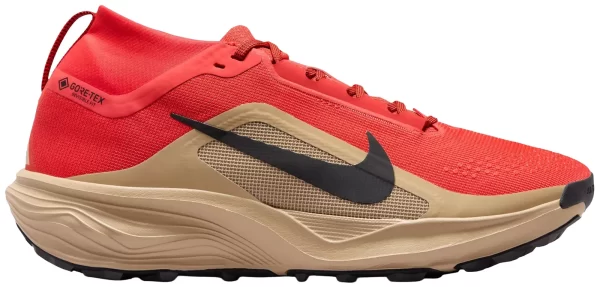
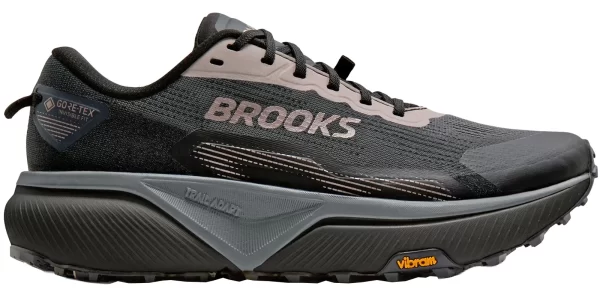
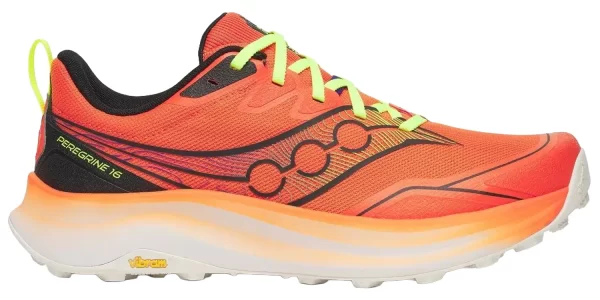
Fit Notes
Fits true to size with a snug forefoot and spacious toe box. No gusset, but tongue is partially attached to upper on the sides. Wide and extra-wide widths available, as well as a GTX version.